Hi everyone, above is a video I produced explaining what androgynous fashion is and my correlating designs I sketched. I’ve used Billy Porter, Janelle Monáe, and Jaden Smith as examples. Two of the designs are based upon two movie characters from Beauty and the Beast (1991) and Halloween (1978). The third sketch is a revamped red carpet look designed by Tom Ford for Zendaya at the 2020 Peoples Choice Awards. My main goal was to showcase how androgynous fashion in film is impactful when it comes to gender and sexuality. Enjoy!
Derek Jarman’s passion for film is exhibited by the 1993 film, Blue. The film features a single steady shot in the color blue that ties a deep poetic and lyrical memoir based on the director Jarman’s struggle with AIDS. Due to Jarman’s illness, it caused a partial blindness where he could only color blue. Its sole shot of one color is about 75 minutes with voiceovers of the director and other actors.
When I initially saw the screen, I was intrigued. “Wait… I know that blue. That’s Klein blues. Yves Klein!” I thought to myself, familiar with the painter. But in all honesty, the excitement vanished after a minute into the film. I realized there would be no other visuals given.
Perhaps you can blame my generation’s shameful and short attention span to social media platforms where we watch either six second, fifteen second, or at most one minute videos before the next stream of videos are shown. This is why I needed to break the film into three parts of 25 minutes each and fully throughout a few days. I attempted to take notes on my phone of what is being said so I could pay closer attention.
Aside from my attention span, I struggled with the narration. The diction and cadence seemed to go over my head when there are no visual examples. I found it tough to understand, especially since I am a textual and visual learner.
When Lombardo wrote, “I am looking at Derek Jarman’s Blue – or I looked at it, and that blue is now inside me, because time past, time present, and time future are but one in transcendence.” I unfortunately wanted nothing but to stop looking at the color of the screen and leave this depressing scene Jarman painted.
Granted, Jarman’s story is heavy, haunting, and full of nostalgia. I learned Jarman was an activist for LGBTQ+ rights “Understand that sexuality is as wide as the sea. Understand that your morality is not law. Understand that we are you. Understand that if we decide to have sex whether safe, safer, or unsafe, it is our decision and you have no rights in our lovemaking.” I also learned he was deeply scared through his anecdotes of battling AIDS. At some parts Jarman is seen as a dreamer hoping for something better than what it’s like for LGBTQ+ person battling aids.
However, I feel as though I am not a fit for this movie. (Is it even a movie when there is no set of moving pictures?) I am sure Derek Jarman knew such an unconventional film would never be everyone’s cup of tea. In fact, I think this movie depicts not only the struggle of an LGBTQ+ member with AIDS, but the passion for film one director can have regardless of the situation. Lombardo said it best in the end of his essay,
“But the immersion into the colour is total, into that colour par excellence that is blue – so mysterious, so inevitably charged with thousands of pictorial and poetic references, like Paris’s sky in Baudelaire‘s ’Le cygne‘…. The daring plunge into the void that the film forces the spectator to take, together with the director and the voices, frees from the constraints of concrete forms. Blue launches the extreme hypothesis that we see mystically and not materially, internally and not externally.” There is something to be said for an ill oppressed man to make such a risky film. And if it “frees from the constraints of concrete forms” for Lombardo, it could for you or anyone else.
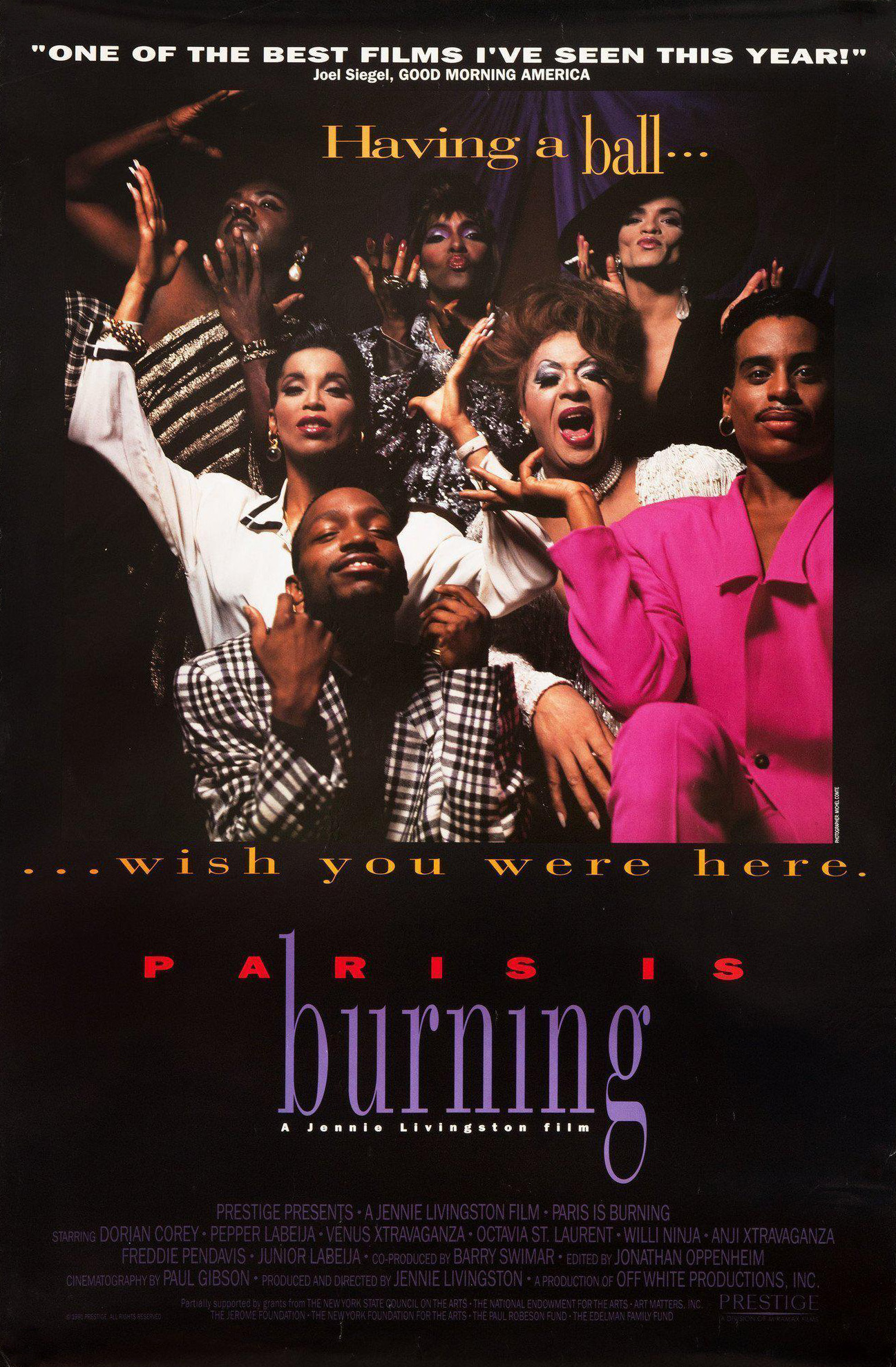
The 1991 documentary, Paris Is Burning, is directed by white lesbian director Jennie Livingston. The documentary focuses on drag queens living in New York City, their house culture, and balls that all provide a sense of community. Community is especially dire for flamboyant and often socially shunned performers. While this film has received a handful of accolades and praise, I for one, was not a fan of this documentary.
To give some benefit of the doubt there are a few aspects of the film that can be applauded. Daniel T. Contreras said in his piece, New Queer Cinema: Spectacle, Race, Utopia, one of the joys of the film is “the courageous, inventive creativity of queers of colour in the most abject of circumstances”. This is true. There is a prominent representation of the Black and Latinx community in New York City. It’s pleasant to see empowered queer people of color celebrating their identity and gain confidence through the Ball whilst dancing, model walking, and dressing up. Yet, that’s probably the only thing I liked about the film.
I agree with Bell Hooks piece Is Paris Burning? and Daniel Contreras’ piece that this movie is essentially… the epitome of glamorizing the white ruling-class. It’s also an exploitation when Livingston is making the lives of people of color into a commodity for white consumption
As I was watching the film I felt saddened by their conditions and only received a surface level education. To me, Livingston films these people, or as what Hooks ironically says “poor souls” with sorrow and pity. She knows this is an interesting story people would watch. As the director, she fails to go past the spectacle of racism, poverty, and why they think a certain way.
If a viewer who is apathetic towards the oppressed watched screens of wealthier white people shopping and happily walking with friends, simultaneously listening to this quote said by Octavia below, they’d assume this woman is shallow, materialistic and envious. When in reality, these women have more depth to them.
“I’d always see the way rich people live, and I’d feel it more, you know, it would slap me in the face, I’d say, ‘I have to have that’, because I never felt comfortable being poor, I just don’t, or even middle-class doesn’t suit me. Seeing the riches, seeing the way people in Dynasty lived, these huge houses and I would think, these people have forty-two rooms in their house, Oh my God, what kind of house is that, and we’ve got three. So why is it that they can have that and I didn’t? I always felt cheated. I always felt cheated out of things like that.”
Instead Livingston should’ve focused on why these people felt the need to associate power with transforming themselves into a white female. If she answered this question, the film would better serve as a noble purpose. She should have “approached her subject with greater awareness of way white supremacy shapes cultural production” (Hooks, 1992) It’s a disturbing thought how some critics found this film to be funny and amazing when it clearly showcased how people of color self-sacrifice themselves to fulfill their fantasies of being upper-class white people. “What Paris is Burning makes poetically clear is that wish fulfilment cannot follow any straightforward political trajectory.” (Contreras, 2004)
In conclusion it’s important to give better representation in new queer cinema. Because this Paris Is Burning “is what makes longing and dream-making such potent and dangerous cultural tools.” (Contreras, 2004)
Director John Carpenter’s 1978 Halloween is a notorious horror movie that set the benchmark for suspense movies and birthed a frenzy genre of slasher films. The film is not based on Michael Meyers, the enigmatic six year old who brutally murdered his older sister Judith and escaped fifteen years later to find his next victims, instead it’s based on three 17 year old girls in a quaint American suburban town. Laurie (the protagonist) and her friends Lynda and Annie are the true main focal points of the story.
Halloween is praised as a feminist movie, but is it? My answer is… hardly. There are three mainstream waves of feminism and it barely reaches the second. Sure the movie surpasses first-wave feminism, but this is expected when the setting is placed in an era where Western women already had the right to vote, receive an education, strive for prestigious powerful positions etc. Carpenter’s meaningful work is subpar compared to second-wave feminism. Second-wave feminism focused on issues transcending political inequalities. Second-wave feminism was formed to improve the social fabric and embedded gender inequalities in the culture of Westernized societies. In 1978, women were victims of false beliefs requiring them to find identity through men and children.
Don’t get me wrong, in many ways Laurie combats the typical girl stereotype. Her appearance of mid-length hair, bare makeup, anad tomboyish clothes of conservative button downs and pants complicates ties between gender. Beyond her appearance, her personality is tenacious and resourceful that oftentimes are more depicted towards men in cinema. It was empowering to see a woman capable of defending herself against a terrifying serial killer.
Yet, ultimately Laurie is unable to kill Michael Meyers. At the end of day, a male detective, Dr. Loomis saves her by shooting the murder mulitple times with a hand gun. The movie reestablishes that there must be patriarchal authority in the world. Laurie is also seen as the “not like other girls” character where she chooses to care more about her work than boys unlike her best friends. Lynda and Annie seem to be indulgent and irresponsible who care more about boys than anything else. This is harmful rhetoric that perpetuates horizontal oppression within women instead of being inclusive. Laurie’s difference is a weakness in the film, when two other girls are problematically portrayed by screenwriter, Debra Hill. It’s disappointing to see a woman writer using negative stereotypes.
To speak of gender roles, Laurie, Lynda and Annie are seen as sole babysitters. It’s sexist to square women into a box of preconceived roles. When Laurie used the majority of household items such as hangers and knitting needles to defend herself she was playing into another sexist cliche. In the end, something did not sit right with me when the virgin survived but the promiscuous women were murdered.
If it wasn’t for the two minute scene where Laurie is in the closet defending herself than Halloween would never be considered a feminist film. The movie is a prime example of why third-wave feminism is needed- due to the narrative of emphasizing only white-middle class women in the past. Third-wave feminism seeded to be inclusive and intersectional. This problem was in many other movies too, “The fact that Cleopatra Jones’s main enemy in both films is a white woman offers possible commentary on the standard criticism that the second wave of feminism primarily catered to issues concerning middle-class white women…. interpreted as a reaction against such perceived exclusions when it comes to feminist political projects. (Hole, Kristin Lené. Film Feminisms (p. 300) Taylor and Francis.) I hope for further movies that include the intersectionality of race and sexuality are applauded more than Halloween is. By no means, I would call Halloween a movie ahead of its time.
I am not one for serious or dark movies. My lame self enjoys the happily ever after ending that gives you a good feeling and an optimism for life afterward. (I.e. my favorite movies are Hidden Figures and The Greatest Showman…not ashamed.) Therefore watching Tangerine was definitely out of my comfort zone. As someone who’s unfamiliar with Transgender slang/vocabulary or culture, it was an educational experience. I came in watching with total ignorance. To be honest I am still ignorant but undoubtedly less.) For instance, they called the Dinah, a cis-gender white woman, a fish. And the immigrant taxi driver is attracted to only transwomen. This was an attractive I never realized some people prefer.
I felt a bit uneasy while watching the cinematic piece, no, not because of the dark setting (which I believe is an informal red-light district frequented by transgender sex workers on the corner of Santa Monica and Highland in LA), genitals, and raw jokes, but then maybe the stereotypical portrayal of black transgender women in the movie. The black transwomen were portrayed cliche as loud, gossipy, and tawdry. My initial thought was “This isn’t right. They’re misrepresenting a whole demographic!” But then I sadly thought to myself… “at least they are getting representation?”
It wasn’t until the ending and the very last scene, where I finally felt the character received just portrayal. When the two black women were sitting on the bench in the laundry mat and fixing each other’s hair. It was the heartfelt moment viewers like me were hoping for. We finally see two women emphasize and show affection to each other even in the harsh realities they live in. Pretty soon, it didn’t even matter that one friend slept with the other’s fiance because they were living in a life where they had more oppressive systems and problems to worry about. I also think the scene where the cis males in a drive-by car threw a cup of urine at Sid-Nee was needed to depict the transphobic attitude they face from the privileged every day.
In The Gaudian article, “Tangerine is a big deal, not just because it was shot on an iPhone” it says, “Baker said that Taylor and Rodriguez are both very close friends with the trans women who work the area. “They basically have witnessed a ton and wanted this story to be told,” he said. Before signing on, however, Rodriguez made one request of Baker. “She said: ‘I trust you, I want to make this movie with you, but you have to promise to show the harsh reality of what goes on out here. These women are here because they have to be, and I want you to make it hilarious and entertaining for us and the women who are actually working the corner.” Plus, it wasn’t like Baker only portrayed characters into a certain niche, I greatly appreciated him showing depth to Alexandria and her aspirations to become a singer.
Not familiar with film art, I wondered why the movie was called “Tangerine”. Thanks to this New York Times article, “Review: ‘Tangerine,’ a Madcap Buddy Picture About Transgender Prostitutes”. I got my answer that’d I’d like to end my blog post with… Mr. Baker hasn’t simply looked in a mirror for his inspiration, but into that infinite world of possibility, that is other people. When he bathes Sin-Dee and Alexandra in the luscious orange of another smoggy Los Angeles sunset, you may note the warm, radiant palette and, almost in passing, admire how the harmonious performances fit with the gracefulness of the filmmaking — but what you see, really see, are two women shimmering in the sun.”
As someone who has not studied film history before, I found the “The Celluloid Closet” an abundance of knowledge. I’d assume before watching Hollywood didn’t acknowledge homosexuality until “Brokeback Mountain” but was I definitely wrong! The documentary explored how within the last century, homosexuality was rarely acknowledged, mostly as something to mock or inspire fear and pity on heteronormativity only (i.e. making the villains gay.) Until the end of the 20th century, homosexuality skewered society’s ideas on how gay people interact and their ideas. Yet, it’s important to acknowledge Hollywood’s double standard between gays and lesbians. “The Celluloid Closet” explained how gay romance and intimacy was seen as a weak, yet Lesbianism was generally more accepted and seen as acceptingly erotic.
The most interesting part of the documentary for me was the “token gesture” of the Hayes Code fascinating. Aside from the documentary, I learned the Hay’s off-limits banned material included smuggling, suggestive dancing, ridicule of religion, miscegenation (mixed-race relationships), white slavery, scenes of passion, and saying the word “pregnant” on screen.
“We will have cleaner and better motions pictures so that they will all stay open.” A huge blow for the LGBTQ+ community considering all gay male characters be eradicated from cinema in 1934. The Hays Code’s sole purpose was to restrict diverse representations of sexuality. But it was “seldom taking seriously.” Thus, more creative directors found ways to get away with it. Screen gays then entered a new phase, becoming evil, predatory villains, portrayed as evil and perverted. Unfortunately, it was something for Gay audiences to be representing in, regardless if they were seen targets as fear and laughable. Then as decades past, more innuendos were seen within gay actors. For example, in what appeared to be a wild west cowboy movie, the gun appeared as phallic symbolism. It was touched, polished, praised, and kept near the man’s penis (signifying the man’s power.)
Personally, “The Celluloid Closet” is a great documentary for viewers like me who identify as an ally, yet I do not expect it to change anyone’s views on the acceptability of LGBTQA+ rights. I believe this documentary was incredibly progressive for its time, yet I noticed it’s still about twenty-five years old. Some references were outdated, especially when they used the term transvestite” which is now an inappropriate and derogatory word. From my understanding it’s connotation is homophobic and seen as a diagnosed medical disorder, a new term I believe is “cross-dressing”. (As someone who is heterosexual I want to be cautious and do not want to claim definitions of words belonging to the LGBTQ+ community.) Secondly, I’m happy there were produced movies seeing gays as finally admirable. Yet, Tom Hanks acting as a Gay lawyer in “Philadelphia” was certainly applauded in the 90s, I do think today we would only want gay actors to play gay characters. While there is definitely more representation needed in cinema, I am happy to see Hollywood only becoming more open towards LGBTQ+ representation in their movies.
Hi, I’m Sara. Originally I am from Indiana but now live in San Francisco. I’m currently based in Orange County going to Chapman University as a creative writing major. I find writing an incredibly powerful tool that will only help me in the future.
I strive for sharing the stories of others and pushing society forward through fashion styling and journalistic writing. I work to juxtapose culture with an insightful meaning to my art. That’s perhaps why I am currently enrolled in the Film, Gender, and Sexuality class. I identify as heterosexual but I want to learn more about the LGBTQ+ community so I can always do my part in making sure they’re represented in my creative work.






 Sara's Blog About Film, Gender, Sexuality